Embodied AI Revolution: Vision-Language-Action Models Now Control Physical Robots
TL;DR: Embodied AI VLA models robotics is the biggest shift in automation since the industrial robot arm. Vision-Language-Action (VLA) models let robots see a scene, understand spoken instructions, and act, all without hardcoded rules. Companies like Physical Intelligence, Figure, and Google DeepMind are already testing these systems in warehouses and homes. This article breaks down what VLA models are, why they matter, and where physical AI warehouse automation is headed next.
What Are Vision-Language-Action Models, Really?
Think of a VLA model as a robot’s brain in software form.
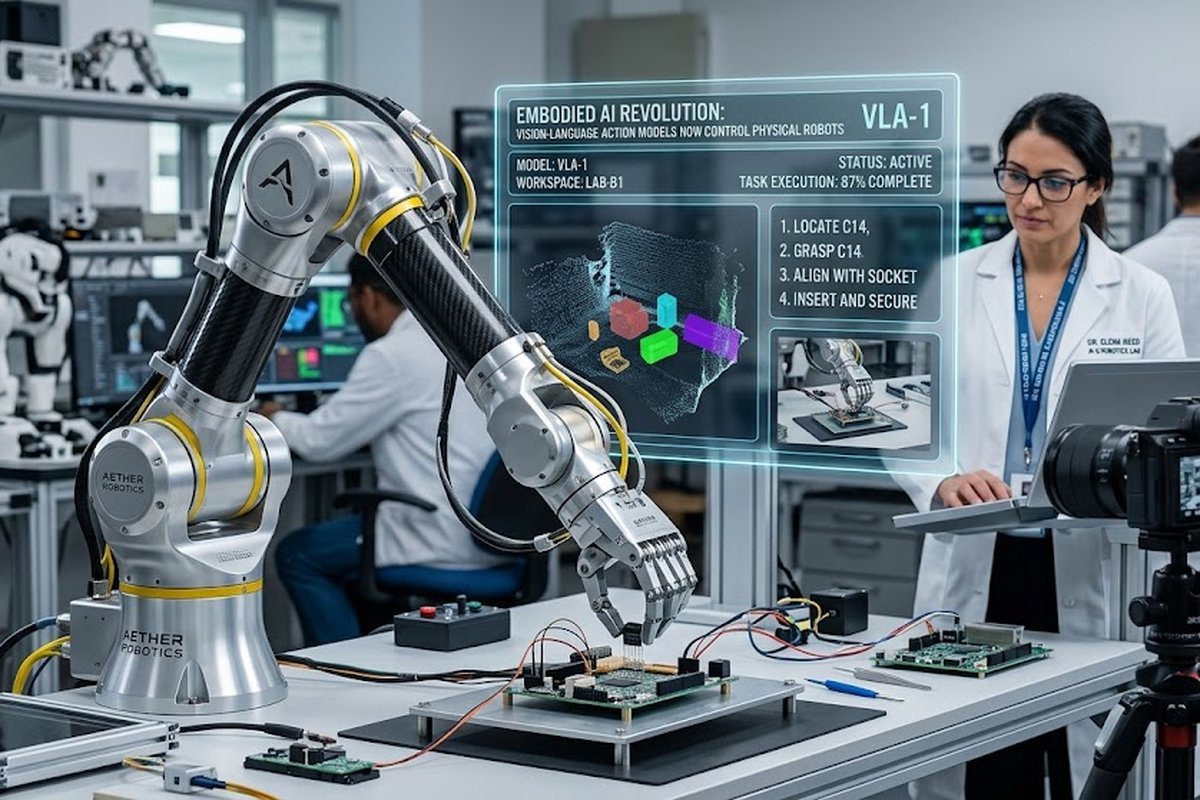
It takes in three types of input. First, it sees the world through cameras. Second, it understands language, like “pick up the blue box.” Third, it turns both into physical movement, like arm rotations or gripper pressure.
Older robots needed engineers to program every single motion. Move here. Rotate there. Stop at this exact angle.
VLA models skip that step. They learn from massive datasets of video, text, and robot motion. Then they generalize. A robot trained on thousands of pick-and-place tasks can often handle a new object it has never seen before.
That’s the real breakthrough. It’s not just automation. It’s adaptable automation.
Why This Is Different From Traditional Robotics
Traditional industrial robots are precise but rigid. A factory arm welding car doors does the same motion thousands of times a day. Change the car model, and someone has to reprogram it.
VLA-powered robots work more like a person learning a new job. Show them a task a few times, or give them a verbal instruction, and they figure out the steps.
This matters because most real-world environments are messy. Warehouses aren’t identical every day. Boxes shift. Lighting changes. Products get repackaged. Rigid robots struggle with that chaos. Embodied AI systems are built to handle it.
The Companies Leading the Embodied AI Push
A handful of players are moving fast.
Physical Intelligence, a startup backed by major AI investors, released its π0 (pi-zero) model in 2024. It’s designed as a general-purpose robot brain that can control different robot bodies, not just one specific machine.
Figure, the humanoid robot company, partnered with OpenAI to bring language understanding into its Figure 02 robot. That robot can now hold conversations while performing physical tasks, like sorting items on a shelf.
Google DeepMind has pushed its own research line, including RT-2 and later successors, which treat robot actions almost like another language the model can “speak.”
Tesla is also in this race with its Optimus humanoid robot, though details on its exact model architecture remain closely guarded.
Each company has a different bet. But the underlying idea is the same. Teach one model to see, understand, and act, then let it generalize across tasks.
Physical AI Warehouse Automation Is the First Real Testing Ground
Warehouses are where this technology is proving itself first. Here’s why.
Warehouses are structured enough to be safe for testing. But they’re also unpredictable enough to be a real challenge. That mix makes them the perfect proving ground for physical AI.
Faster Fulfillment Without Full Redesigns
Amazon has used robotics in its warehouses for years, mostly through its Kiva-based systems and newer robots like Proteus and Sparrow. But most of those older systems still rely on fixed programming.
VLA models change that. A robot can be told, in plain language, to “grab the item in aisle 12 and bring it to packing station 3.” No new code required.
That reduces setup time. It also lowers the cost of retraining robots when product lines change, which happens constantly in e-commerce.
Fewer Errors, More Flexibility
Traditional automation breaks when something unexpected happens. A dropped box. A mislabeled item. A shelf that’s slightly out of place.
VLA-based robots use real-time vision to adjust. If a box isn’t exactly where it’s supposed to be, the robot can still locate it, because it’s reasoning about the scene, not just following fixed coordinates.
This is a big deal for warehouse automation companies trying to cut labor costs while avoiding costly downtime.
How VLA Models Actually Learn
It helps to understand the training process, because it explains both the promise and the limits.
Most VLA models are trained on huge datasets that combine:
- Internet-scale text and image data (similar to what powers ChatGPT or Gemini)
- Robot-specific motion data, often collected from real robot arms performing tasks
- Simulation data, where robots practice in virtual environments before touching real hardware
This combination lets the model connect language (“pour the water”) with vision (seeing a cup) and action (tilting a gripper at the right angle).
The Simulation Advantage
Simulation is a huge part of why progress has sped up. Companies like NVIDIA, through its Isaac Sim platform, let robots practice thousands of task variations in virtual space before ever touching physical hardware.
This cuts cost. It also cuts risk. A robot can fail a million times in simulation with zero consequences, then arrive at the real warehouse floor already competent.
What’s Holding This Technology Back
It’s not all smooth sailing.
VLA models still struggle with precision tasks that require fine motor control, like threading a needle or assembling small electronics. Vision systems can also get confused by poor lighting, reflective surfaces, or cluttered scenes.
There’s also the cost problem. Humanoid robots like Figure 02 or Tesla’s Optimus are still expensive to build and maintain at scale. Warehouses need thousands of units to matter economically, and that math doesn’t work yet for most operators.
Safety certification is another hurdle. Regulators are still figuring out how to test AI-driven physical systems that make real-time decisions, rather than following fixed scripts.
Where This Is Headed Next
Expect embodied AI to move beyond warehouses within the next few years.
Healthcare, elder care, and retail are all being floated as next frontiers. Hospitals could use VLA-driven robots to assist with lifting patients or restocking supplies. Retail stores could use them for shelf-scanning and inventory checks.
The pattern will likely repeat. Warehouses first, because they’re controlled but complex. Then homes and public spaces, once safety and cost problems shrink.
The pace of progress over the last two years suggests this timeline could move faster than most industry watchers expect.
Key Takeaways
- Embodied AI VLA models robotics combines vision, language understanding, and physical action into one adaptable system, replacing rigid, hardcoded robot programming.
- Companies like Physical Intelligence, Figure, Google DeepMind, and Tesla are racing to build general-purpose robot “brains” that work across multiple tasks and robot bodies.
- Physical AI warehouse automation is the current proving ground, offering structured but unpredictable environments where flexibility matters more than raw speed.
- Simulation platforms, like NVIDIA’s Isaac Sim, are accelerating training by letting robots practice safely before real-world deployment.
- Cost, precision limits, and safety regulation remain the biggest barriers before embodied AI spreads beyond warehouses into healthcare, retail, and everyday life.