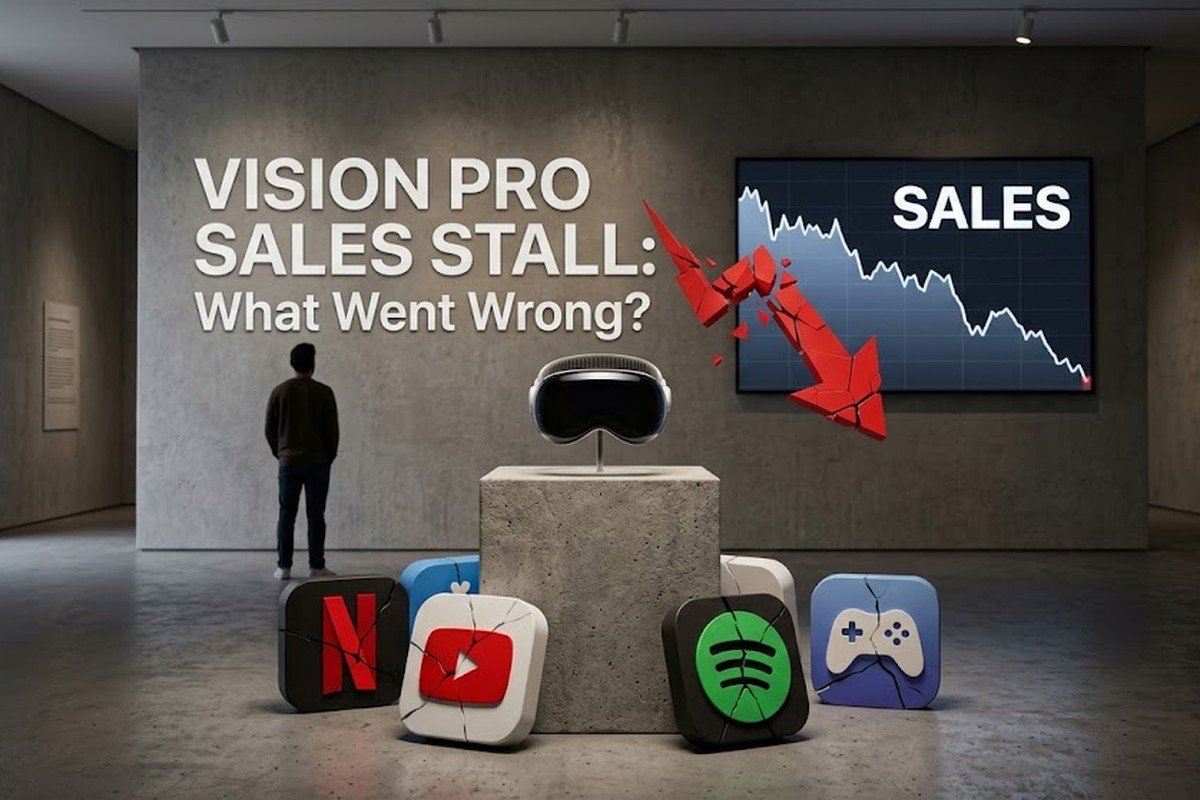
Apple’s $3,499 Vision Pro headset was supposed to revolutionize computing. Instead, six months after its February 2024 launch, the spatial computer is collecting dust on store shelves. Recent reports suggest daily U.S. sales have plummeted to fewer than 1,000 units—a stunning decline for a product Apple CEO Tim Cook once called “tomorrow’s technology today.”
The honeymoon period ended quickly. After an initial surge driven by early adopters and Apple enthusiasts, Vision Pro sales have dropped approximately 90% from launch week numbers. Market research firm IDC estimates Apple sold roughly 370,000 units through the end of June, far below the company’s internal projections. For context, Meta sold over 20 million Quest headsets in 2023 alone, albeit at a fraction of Vision Pro’s price point.
What happened? The Vision Pro isn’t failing because it’s bad technology—quite the opposite. Reviews consistently praise its stunning display quality, intuitive eye-tracking interface, and seamless integration with Apple’s ecosystem. The problem runs deeper than product quality, touching on fundamental questions about consumer readiness for spatial computing and whether Apple miscalculated its market.
The Price Barrier Nobody Could Ignore
At $3,499 for the base 256GB model, Vision Pro costs more than many people’s monthly rent. Apple positioned the device as a premium product for professionals and creative workers, but that strategy assumed a use case compelling enough to justify the expense. For most consumers, that use case never materialized.
Professional applications remain limited. Video editors and 3D designers—supposedly prime candidates for spatial computing—found the headset impressive during demos but struggled to integrate it into actual workflows. The weight (approximately 600 grams) makes extended wearing sessions uncomfortable, and the external battery pack, while innovative, adds another point of friction to the user experience.
Compare this to Meta’s Quest 3, priced at $499, or even the Quest Pro at $999. While neither matches Vision Pro’s technical sophistication, both deliver compelling mixed reality experiences at prices consumers can rationalize. Apple bet that superior quality would overcome price resistance. The market disagreed.
Content Drought and the App Problem
Hardware doesn’t exist in a vacuum. Vision Pro launched with roughly 600 native applications—a respectable number for a first-generation platform. But six months later, the app ecosystem hasn’t exploded the way iPhone’s did. Major developers remain cautious about investing resources into visionOS applications when the installed base hovers below 400,000 users.
The entertainment value proposition feels particularly undercooked. Yes, watching movies on a virtual 100-foot screen delivers a wow factor. But that novelty wears off when you’re wearing a headset that costs as much as a used car. Gaming selection remains sparse, with major publishers adopting a wait-and-see approach. Social applications—potentially transformative in spatial computing—barely exist beyond Apple’s own FaceTime implementation.
Netflix’s absence from the platform speaks volumes. The streaming giant declined to create a native Vision Pro app, forcing users to access content through the Safari browser. When the world’s dominant streaming service won’t commit resources to your platform, it signals deeper ecosystem concerns.
Market Reality Versus Apple’s Vision
Apple may have misjudged consumer appetite for spatial computing entirely. The company excels at refining existing product categories—smartphones, tablets, smartwatches—and making them indispensable. But creating entirely new categories proves considerably harder, as Google Glass demonstrated in 2013.
The broader XR (extended reality) market hasn’t grown as analysts predicted. Meta has invested over $40 billion in Reality Labs since 2019, yet mainstream adoption remains elusive. If Meta—with its social platform advantages and aggressive pricing—struggles to make VR/AR mainstream, Apple faces an uphill battle despite its brand strength.
Manufacturing adjustments tell their own story. Reports suggest Apple has reduced Vision Pro production significantly, with supplier Luxshare scaling back assembly operations. Some analysts believe Apple may ship fewer than 500,000 units in 2024, far below the company’s rumored initial target of 1 million units.
What Comes Next for Spatial Computing
Apple rarely admits defeat publicly, and the company has historically played the long game with new product categories. The first Apple Watch faced similar skepticism before finding its footing as a health and fitness device rather than a communication tool. Vision Pro could follow a similar trajectory, pivoting toward specific professional niches where its premium capabilities justify the cost.
Rumors of a cheaper Vision headset—potentially priced around $1,500-$2,000—suggest Apple recognizes the pricing problem. Such a device would sacrifice some premium features, possibly using lower-resolution displays or iPhone-based processing, to reach a broader audience. However, manufacturing a significantly cheaper headset while maintaining the Vision Pro experience presents serious engineering challenges.
The technology itself remains extraordinary. Eye-tracking precision, passthrough video quality, and spatial audio implementation represent genuine innovations. But innovation without adoption remains just expensive R&D. Apple needs either killer applications that make Vision Pro indispensable for specific workflows, or a fundamental rethinking of pricing and positioning.
For now, Vision Pro serves as an expensive reminder that even Apple can’t force-feed consumers a new product category before they’re ready. Spatial computing may indeed represent the future of human-computer interaction. But the present remains stubbornly attached to smartphones, laptops, and displays that don’t require strapping equipment to your face. Apple’s challenge isn’t building better spatial computers—it’s convincing people they need spatial computers at all.