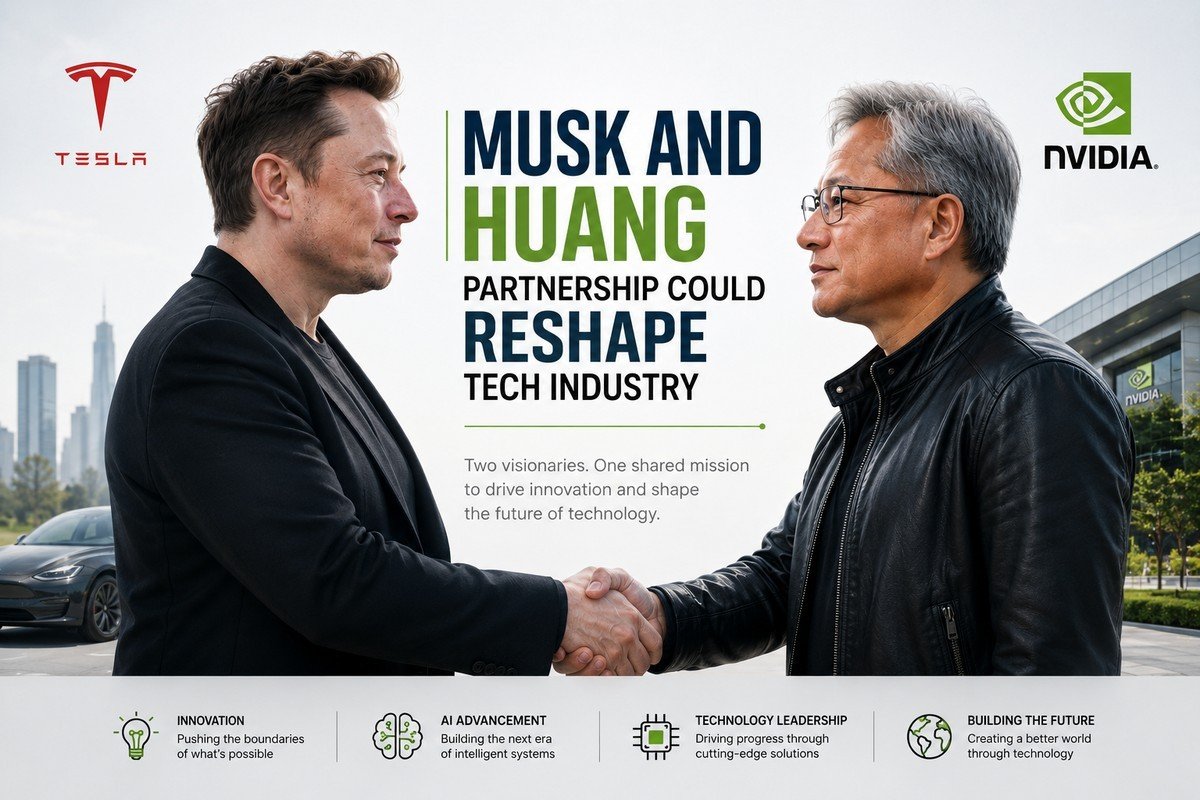
When two of the technology industry’s most powerful figures align their interests, the ripple effects can reshape entire markets. Recent reports suggest that Elon Musk and NVIDIA CEO Jensen Huang may be exploring a partnership that could define the next chapter of artificial intelligence development. While specific details remain under wraps, the mere possibility of these tech titans joining forces has sparked intense speculation about what such collaboration might produce.
The timing couldn’t be more significant. As AI infrastructure demands explode and competition for computational resources intensifies, strategic alliances between hardware providers and ambitious AI developers have become increasingly valuable. Musk’s ventures—from Tesla’s autonomous driving ambitions to xAI’s ChatGPT competitor—require massive computing power. Huang controls the company supplying roughly 80% of AI accelerator chips worldwide. The synergy seems almost inevitable.
Why This Partnership Makes Strategic Sense
NVIDIA has established itself as the undisputed leader in AI chip manufacturing, with demand for its H100 and newer Blackwell GPUs far outstripping supply. Every major AI project, from OpenAI’s GPT models to Google’s Gemini, runs on NVIDIA silicon. Musk, meanwhile, operates multiple ventures with voracious appetites for computational power.
Tesla’s Full Self-Driving technology requires training massive neural networks on petabytes of video data. xAI, Musk’s latest venture launched to compete with ChatGPT, announced plans to build one of the world’s largest AI supercomputers. Even X (formerly Twitter) needs substantial computing resources for content moderation, recommendation algorithms, and potential AI features.
Previous tensions between Musk and NVIDIA have been documented, particularly around chip allocation during supply shortages. A formal partnership could ensure priority access to cutting-edge hardware while potentially offering NVIDIA valuable feedback and real-world testing grounds for new architectures. It’s a relationship where both parties bring critical assets to the table.
Potential Impact on AI Development
The convergence of Huang’s hardware expertise and Musk’s aggressive development timelines could accelerate AI capabilities in several key areas. Autonomous vehicles represent the most obvious beneficiary. Tesla has already invested billions in custom AI training infrastructure, but access to the latest NVIDIA technology could compress development cycles significantly.
More intriguingly, xAI could emerge as a serious challenger to established players like OpenAI and Anthropic. Musk has publicly criticized the AI safety approaches of other companies, arguing for different development philosophies. With guaranteed access to top-tier computing resources, xAI could pursue alternative architectures and training methodologies that current resource constraints might otherwise prohibit.
The broader industry implications extend beyond these individual companies. A Musk-Huang alliance could shift negotiating power in the AI chip market, potentially influencing pricing structures and allocation priorities. Other AI developers might find themselves competing more intensely for the same limited GPU supplies, particularly if NVIDIA dedicates significant production capacity to Musk’s ventures.
Industry Reactions and Competitive Dynamics
Such a partnership wouldn’t unfold in a vacuum. Competitors are watching closely and preparing responses. Microsoft, deeply invested in OpenAI, has announced custom AI chip designs to reduce dependence on NVIDIA. Google has long manufactured its own Tensor Processing Units. Amazon’s AWS division develops Trainium chips for machine learning workloads.
Yet none of these alternatives have matched NVIDIA’s performance benchmarks or software ecosystem maturity. CUDA, NVIDIA’s programming platform, has become the de facto standard for AI development. Switching costs remain prohibitively high for most organizations, giving NVIDIA—and by extension, its partners—tremendous leverage.
The regulatory environment adds another layer of complexity. Both Musk and Huang operate companies facing intense scrutiny. Tesla navigates autonomous vehicle regulations across multiple jurisdictions. NVIDIA’s proposed acquisitions have faced antitrust challenges. A formal partnership might attract regulatory attention, particularly if it appears to create preferential access that disadvantages competitors.
What Remains Uncertain
Without official confirmation, the exact nature and scope of any Musk-Huang collaboration remains speculative. The reports emerging from Yahoo Finance and other outlets confirm industry buzz but lack concrete details about agreements, timelines, or specific technologies involved.
Several scenarios seem plausible. A straightforward supply agreement would guarantee Tesla and xAI access to new chip generations. A deeper technical collaboration might involve co-developing specialized hardware for specific AI applications. The most ambitious possibility would be a joint venture targeting breakthrough technologies that neither company could efficiently pursue alone.
Historical precedent offers limited guidance. Musk’s business relationships often defy conventional partnership models. His tendency to vertically integrate—building in-house capabilities rather than relying on external suppliers—suggests any arrangement would need compelling strategic logic beyond simple procurement guarantees.
Looking Forward
Whether this partnership materializes as reported or remains speculative, the underlying forces driving such collaboration won’t dissipate. AI development has entered a phase where computational resources directly determine competitive positioning. Companies that secure reliable access to cutting-edge hardware gain measurable advantages in model training speed, capability, and cost efficiency.
Musk and Huang represent complementary strengths in this evolving landscape. One commands the infrastructure; the other pushes the boundaries of application. If they’ve found common ground, the resulting synergy could indeed usher in meaningful technological advances. The alternative—continued competition for scarce resources—serves neither party’s interests when larger strategic opportunities beckon.
The technology industry has always progressed through unexpected alliances between visionary leaders. This potential partnership, if it comes to fruition, fits that pattern. For now, the details remain frustratingly opaque, but the strategic logic seems sound. Time will reveal whether speculation transforms into substantial collaboration—and what that means for the future of artificial intelligence.