Nvidia’s Jensen Huang said it plainly at CES 2026: “The ChatGPT moment for robotics has arrived.” That’s a bold claim from a chip company, but the order books back it up, with humanoid robot production commitments up over 300% year-over-year according to multiple supply chain reports out of Taiwan and China. The embodied ai hardware boom isn’t a prediction anymore. It’s a supply chain problem.
The core takeaway: physical AI hardware is booming in 2026 because three things finally lined up at once, cheap enough sensors, foundation models that generalize across robot bodies, and manufacturers desperate for automation as labor costs keep climbing.
What’s Actually Driving the Embodied AI Hardware Boom Right Now
The boom is driven by falling actuator and sensor costs meeting general-purpose AI models that no longer need custom training for every single task. A humanoid robot chassis that cost $250,000 to prototype in 2022 now runs closer to $30,000 to $50,000 in component costs, based on teardown estimates from Figure AI and Unitree. That price collapse changes everything.
Three forces are converging at the same time:
- Foundation models generalize now. Companies like Physical Intelligence and Google DeepMind’s Gemini Robotics team have shown models that transfer skills across different robot arms without retraining from scratch.
- China’s supply chain matured fast. Unitree’s G1 humanoid retails around $16,000, a price point that would have been laughed out of the room three years ago.
- Labor economics flipped. US manufacturing wages plus chronic warehouse staffing shortages made a $50,000 robot with a 3-year payback period look cheap, not risky.
None of these alone would cause a boom. Together, they created the conditions for one.
Which Companies Are Actually Shipping Hardware, Not Just Demos
Figure AI, Tesla, Unitree, and Boston Dynamics are the four companies with robots doing real paid work today, not lab demos. Everyone else, including some famous names, is still mostly in pilot mode or investor-deck territory.
Figure AI
Figure’s 03 model, unveiled in late 2025, is deployed in BMW’s Spartanburg plant doing sheet metal handling. Figure has publicly stated it wants to ship 100,000 units over the next four years through its BotQ manufacturing line in San Jose. That’s an aggressive number, but their $675 million funding round in early 2024 (and the follow-on raise since) suggests investors believe the timeline.
Tesla Optimus
Tesla’s Optimus V3 is the one everyone watches because of Elon Musk’s track record of missed dates. Musk has said Tesla wants to produce “a few thousand” units in 2026 for internal factory use before any external sales. Skepticism is warranted here. Tesla has slipped Optimus timelines before, and full-scale production has not been independently verified by any third party as of this writing.
Unitree and Boston Dynamics
Unitree dominates the low-cost end, with its G1 and H2 models used heavily in Chinese research labs and increasingly in US university robotics departments. Boston Dynamics, now under Hyundai ownership, is quieter on hype but has real deployments of its Atlas humanoid in Hyundai’s own plants doing parts sequencing.
Why Robotics AI Integration Trends Are Different This Time
Robotics ai integration trends this cycle are different because the AI model and the hardware are being developed together, not bolted together after the fact. Previous robotics waves failed because software teams and hardware teams barely talked to each other. That’s changed.
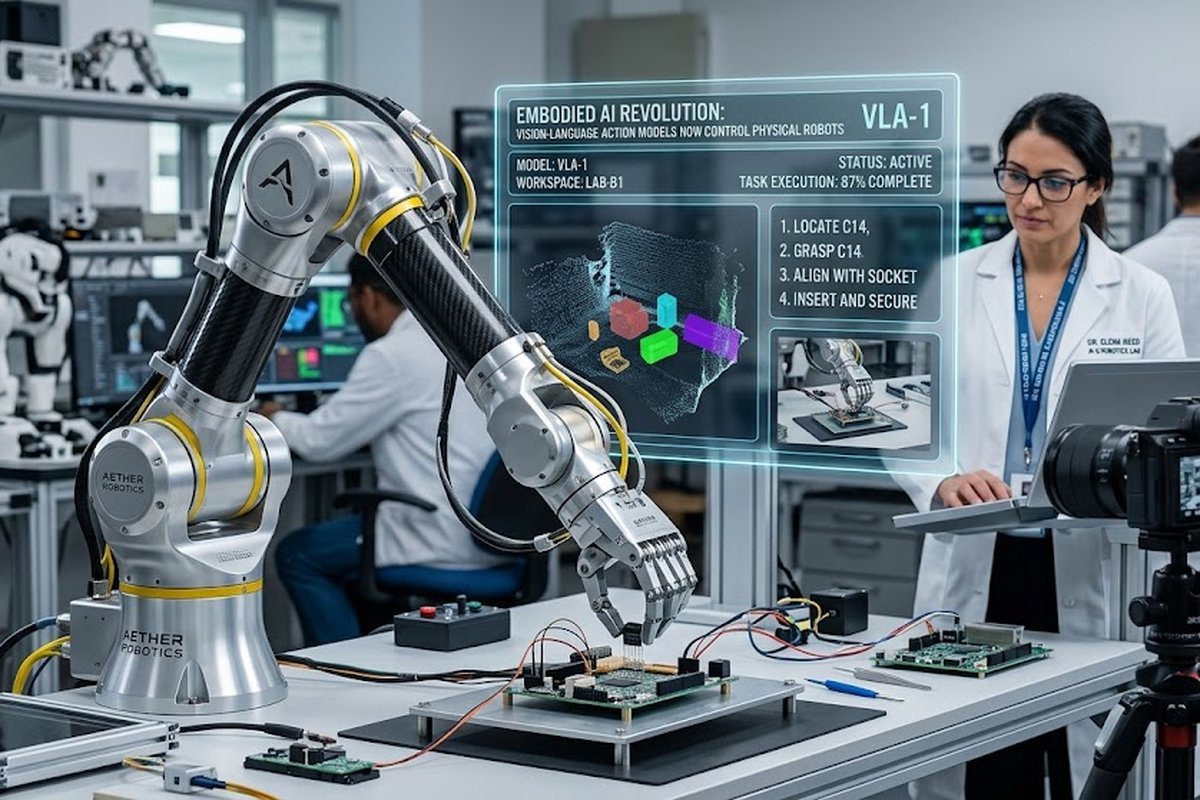
Nvidia’s Jetson Thor platform, launched in 2025, packs 800 teraflops of AI compute onto a board small enough to fit in a humanoid’s torso. That’s roughly triple the compute of the previous Jetson Orin generation, and it means robots can run vision-language-action models locally instead of phoning home to a data center with 200ms of latency. Latency is the silent killer of robot dexterity. A robot that has to wait a fifth of a second to decide whether it’s gripping a cup or a wrench is not a robot you want near people.
Nvidia isn’t just selling chips either. Its Isaac Sim platform lets companies train robots in simulation for thousands of virtual hours before a single physical unit gets built. That’s why hardware companies with zero robotics history, like several EV suppliers pivoting into actuators, have been able to enter the market fast. The simulation-to-reality pipeline shortened what used to be a five-year hardware development cycle into something closer to 18 months.
Who Should Actually Buy Into This Now (And Who Should Wait)
Enterprises with repetitive, injury-prone physical tasks, warehouse picking, automotive assembly, and hazardous material handling, should be evaluating pilots now. Consumers and small businesses should wait at least 12 to 18 months for prices and reliability data to mature.
Good Fits for 2026 Deployment
- Auto manufacturers already running Figure or Atlas pilots have existing safety infrastructure and floor space designed for robots.
- Warehouse and logistics operators with high injury rates in picking and lifting roles see the fastest ROI.
- Research universities and robotics labs benefit from Unitree’s low entry price even if the hardware isn’t factory-grade reliable yet.
Who Should Hold Off
Small manufacturers and consumer buyers should wait. Support networks for repair and parts are thin outside major metro areas, and firmware updates are shipping fast enough that a unit bought in January could be functionally outdated by summer. That’s not a knock on the tech. It’s just where the market is.
What Could Slow the Embodied AI Hardware Boom Down
The biggest risks to this boom are battery density limits, chip export restrictions, and a possible gap between demo footage and real-world reliability. Any one of these could stall momentum through 2026 and 2027.
Battery energy density hasn’t kept pace with compute gains. Most humanoids today get 2 to 4 hours of runtime before needing a charge, which is fine for a demo video and a real constraint on a factory floor running two shifts. Export controls on advanced chips between the US and China also loom large, since both countries are racing to dominate this hardware category and neither wants the other holding the compute advantage.
There’s also a quieter risk: hype fatigue. Boston Dynamics’ original Atlas parkour videos went viral in 2013. It took over a decade to get from viral video to paid factory deployment. Investors chasing the current embodied ai hardware boom should remember that gap.
Frequently Asked Questions
Is the embodied AI hardware boom actually real or just hype? It’s real but uneven. Figure AI, Tesla, Unitree, and Boston Dynamics have verified paid deployments in factories today. Many other companies announcing humanoid robots are still in prototype or fundraising stages, not shipping.
How much does a humanoid robot cost in 2026? Prices range from about $16,000 for Unitree’s G1 to well over $100,000 for enterprise-grade units from Figure AI or Boston Dynamics. Component costs have dropped roughly 80% since 2022 due to cheaper sensors and actuators.
Which industries are adopting robotics AI integration first? Automotive manufacturing, warehouse logistics, and hazardous material handling are leading adoption. These industries have high injury rates, repetitive tasks, and existing budget for automation, making robot payback periods shortest there.
Will Tesla Optimus actually ship in 2026? Tesla plans internal factory use for a few thousand units in 2026, according to Elon Musk’s public statements. No independent third party has verified mass production numbers yet, so treat announced timelines with caution.
What’s limiting humanoid robots from wider adoption? Battery runtime, currently 2 to 4 hours per charge, and thin repair infrastructure outside major cities are the main practical limits. Chip export restrictions between the US and China add supply chain uncertainty too.
The embodied ai hardware boom is less a single moment and more three slow-building trends, cheaper components, generalizable AI models, and desperate labor markets, hitting critical mass at the same time. It’s not hype-free, and buyers should separate companies actually shipping units from ones still shipping demo reels.
- Figure AI, Tesla, Unitree, and Boston Dynamics are the only companies with verified paid robot deployments as of early 2026.
- Component costs have dropped roughly 80% since 2022, making humanoid robots commercially viable for the first time.
- Battery life (2-4 hours) and thin repair networks remain the biggest practical barriers to wider adoption.
- Enterprises with repetitive physical tasks should pilot now; consumers and small businesses should wait 12-18 months.
- Watch chip export policy and battery density research as the two biggest swing factors for 2027 and beyond.