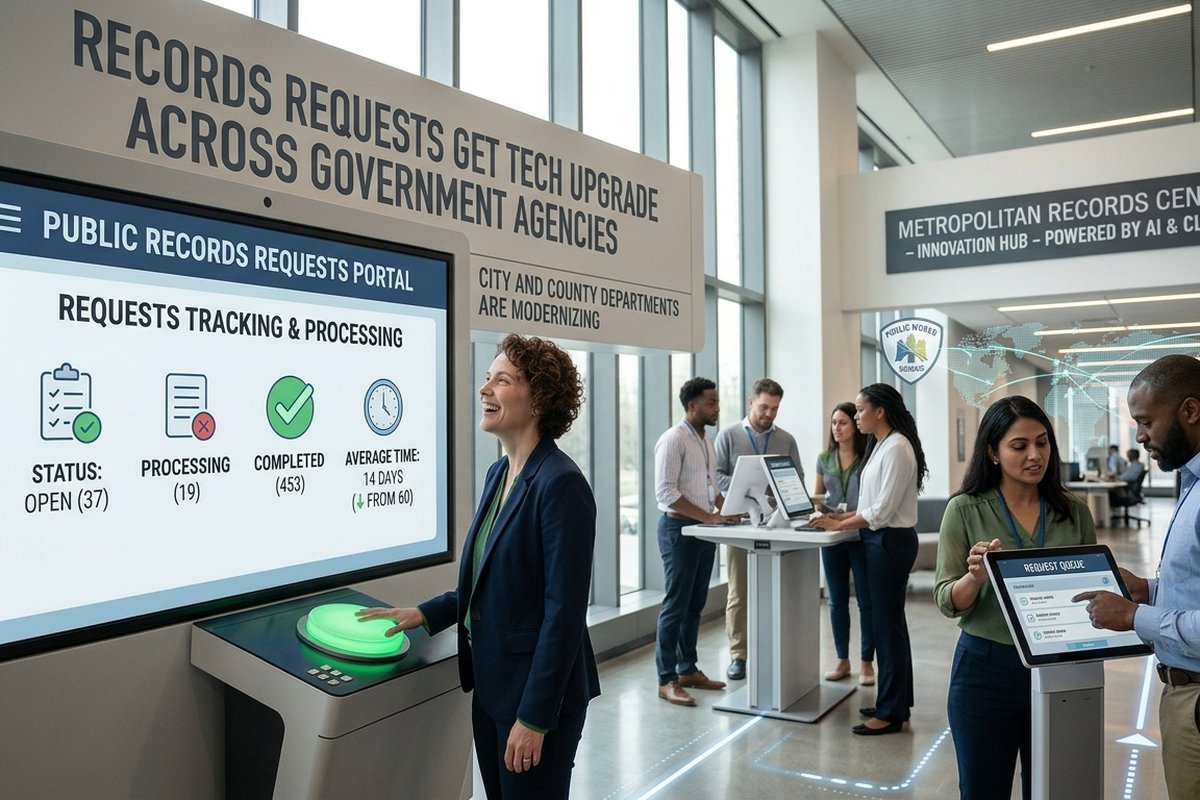
Government agencies nationwide are finally catching up to the private sector when it comes to records management. After years of bureaucratic delays and manual processing that frustrated journalists, citizens, and healthcare providers alike, a wave of technology upgrades is transforming how public records requests get fulfilled.
The shift comes at a critical moment. As data breach incidents continue their upward trajectory and demand for government transparency intensifies, agencies can no longer rely on outdated systems that treat every records request like a scavenger hunt through filing cabinets—digital or otherwise.
The numbers tell the story. By February 2026, the Trusted Exchange Framework and Common Agreement (TEFCA) had already facilitated the exchange of nearly 500 million health records. That’s not just a statistic—it represents hundreds of thousands of hours saved for both government workers and the people they serve.
Why Legacy Systems Are Breaking Down
The burden on government staff processing records requests has reached unsustainable levels. Traditional methods involve manually searching multiple databases, redacting sensitive information by hand, and coordinating across departments that often use incompatible systems. A single comprehensive records request can consume weeks of staff time.
Healthcare organizations have felt this pain acutely. Patient records often span multiple providers, insurance companies, and government agencies. Before interoperability solutions, assembling a complete medical history meant faxing requests, making phone calls, and waiting for responses that might arrive in formats ranging from PDFs to actual paper documents.
The Department of Health and Human Services recognized that technology could slash this burden. Their push to leverage artificial intelligence and automated systems represents more than efficiency gains—it’s about making government services actually work in the digital age.
How Modern Technology Changes the Game
The technical architecture behind these improvements centers on interoperability—the ability of different systems to communicate seamlessly. TEFCA establishes common standards that allow healthcare providers, insurers, and government agencies to exchange information without custom integration for each connection.
AI enters the picture primarily through intelligent redaction and classification. Rather than having staff manually review every page to black out Social Security numbers or protected health information, machine learning algorithms can identify and redact sensitive data automatically. Human reviewers still verify the work, but the initial heavy lifting happens in seconds instead of hours.
Local governments are adopting similar approaches for public records beyond healthcare. Police departments are implementing systems that can pull together body camera footage, incident reports, and dispatch logs through automated searches. Municipal governments are creating portals where citizens can submit requests and track their status in real-time, rather than wondering if their email disappeared into a bureaucratic void.
The Santa Fe New Mexican’s coverage of these updates reflects a broader national trend. While specific local implementation details vary by jurisdiction, the underlying principle remains consistent: replace manual, time-intensive processes with automated workflows that maintain privacy protections while dramatically improving speed.
The Security Question Nobody’s Ignoring
Here’s the uncomfortable reality: healthcare data breaches are trending upward, according to tracking by HIPAA Journal. More connectivity and data sharing could theoretically expand the attack surface for malicious actors.
This concern has shaped how these systems get deployed. TEFCA includes stringent security requirements that participating organizations must meet. Encryption standards, access controls, and audit logging are baked into the framework rather than treated as afterthoughts.
The calculus isn’t whether technology introduces any risk—all technology does. The question is whether modern, well-designed systems with active monitoring are safer than the status quo of scattered databases, fax machines, and file cabinets. Security experts increasingly argue that centralized, standardized approaches with proper safeguards actually reduce risk compared to the fragmented mess they replace.
What This Means for Transparency and Access
Faster records processing should strengthen government accountability. When fulfilling a records request takes months, some requesters give up. Investigations lose momentum. Public interest wanes. Reducing that timeline from months to days or weeks keeps accountability efforts viable.
Professional associations like the American Dental Association have noted how interoperability benefits extend beyond government transparency. Dentists can access relevant medical history faster, improving patient care. Researchers can aggregate anonymized data more efficiently. Insurance claims processing accelerates.
Law enforcement benefits are significant too. When officers need records from other jurisdictions, current systems often require phone calls and informal networks. Technology platforms designed for secure inter-agency sharing mean investigations don’t stall waiting for faxed documents.
The burden reduction cuts both ways. Government staff spend less time on routine requests, freeing capacity for complex inquiries that genuinely need human expertise. Requesters get faster responses and better tracking. It’s a rare government technology project where almost everyone wins.
Looking Ahead
The 500 million records exchanged through TEFCA represent just the beginning. As more organizations join the framework and AI capabilities improve, the efficiency gains will compound. Local governments watching early adopters succeed will face pressure to modernize their own systems.
Challenges remain. Smaller jurisdictions lack the budget for cutting-edge systems. Legacy data in incompatible formats will take years to migrate. Staff need training on new tools. Privacy advocates will rightfully scrutinize every implementation.
But the direction is clear. Government records management is moving from manual processing to intelligent automation, from fragmented databases to interoperable networks, from opaque timelines to transparent tracking. The technology exists. The frameworks are established. Now comes the harder work of actually deploying these solutions everywhere they’re needed—and ensuring they serve the public interest rather than just reducing paperwork.