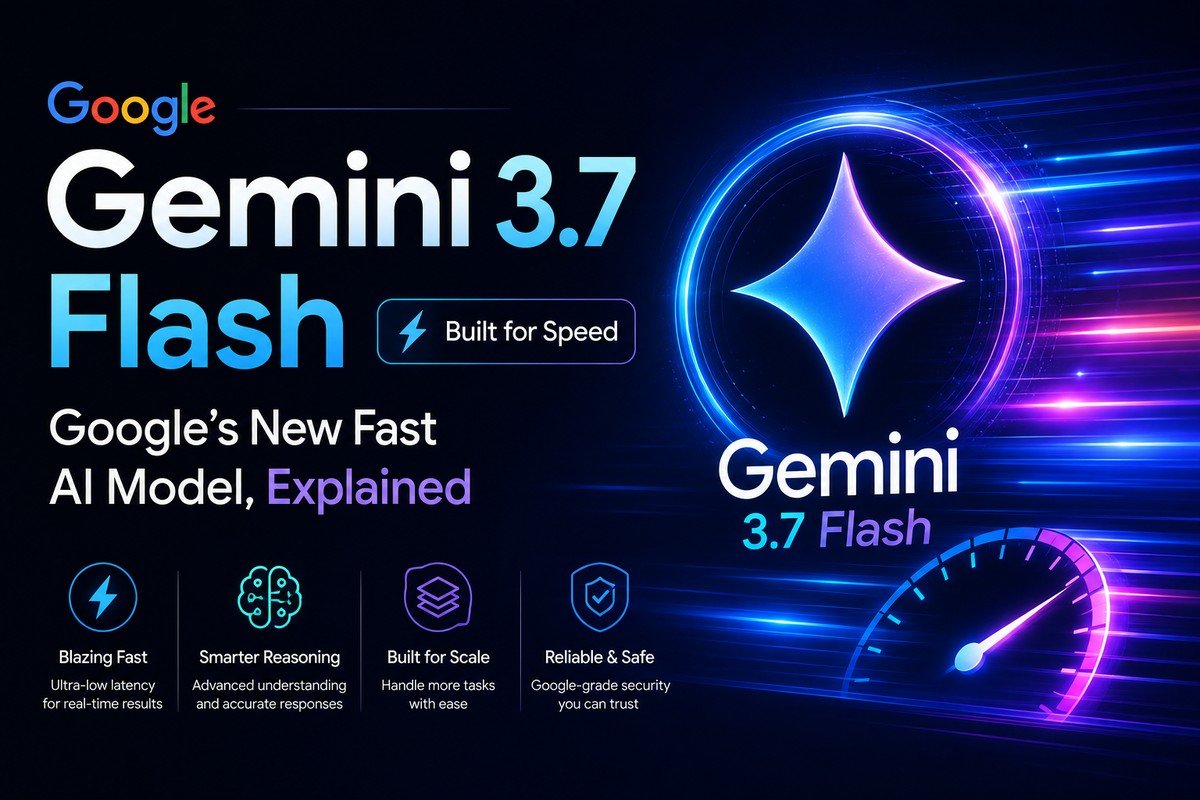
Google just launched Gemini 3.7 Flash, and it’s the fastest, most capable version of their speed-focused AI model yet. Announced on August 13, 2026, this newest iteration represents a major leap forward in balancing raw intelligence with blazing-fast inference times—making it the go-to choice for developers building real-time, production-scale AI applications.
While competitors focus on raw parameter counts and benchmark scores, Google is betting that the future belongs to AI that responds instantly. As AI moves from experimental chatbots into production systems powering customer service, coding assistants, and real-time translation, latency has become the make-or-break metric. Nobody wants to wait three seconds for an AI to compose an email reply or debug a line of code.
How Fast Is Gemini 3.7 Flash Compared to GPT-4?
Google’s Gemini 3.7 Flash is engineered for one thing above all else: getting answers to users faster than competing models. According to Google’s official announcement, the model delivers significant speed advantages while maintaining competitive reasoning capabilities. The architecture supports multimodal input and output—text, images, audio, and video—while keeping response times dramatically lower than larger models like GPT-4.
The key insight: Gemini 3.7 Flash matches or exceeds GPT-4’s performance on several key metrics while responding in a fraction of the time. For developers, this means building responsive AI applications just got significantly easier. Features that required careful optimization and caching strategies to feel snappy can now run with straightforward API calls.
More importantly, the model includes native tool use and function calling capabilities. Developers can connect it directly to APIs, databases, and external services without wrestling with complex middleware. This architectural decision dramatically reduces the engineering overhead for production deployments.
What Can Gemini 3.7 Flash Do? (Multimodal Text, Image, Audio, Video)
The Flash model’s multimodal nature extends beyond simple image recognition. It can analyze video streams in real-time, extract data from complex documents with mixed text and graphics, and generate audio responses with natural speech patterns.
For enterprise applications, this translates to practical capabilities: analyzing surveillance footage, processing insurance claim photos, extracting structured data from scanned forms—all at speeds that make interactive applications feasible. A customer service bot can look at a photo a customer sends and provide specific troubleshooting guidance in seconds, not minutes.
The audio processing capabilities deserve particular attention. The model can handle voice input with low latency, making it suitable for voice assistants and real-time translation applications where even a one-second delay feels unnatural. Early testing suggests response times comparable to human conversation speeds, a threshold that previous AI models struggled to reach consistently.
Google has also emphasized the model’s ability to maintain context across long conversations and complex documents. The extended context window means developers can build applications that reference entire codebases, lengthy contracts, or multi-hour meeting transcripts without chopping inputs into frustrating chunks.
Why Google Prioritized Speed Over Raw Power
Google’s focus on inference speed reflects hard lessons learned from AI deployment at scale. The company runs some of the world’s highest-traffic AI services through Search, Gmail, and Google Workspace. They’ve seen firsthand how latency impacts user satisfaction and operational costs.
Faster models don’t just improve user experience—they reduce infrastructure costs. Every millisecond shaved off response time means fewer servers needed to handle the same query volume. At Google’s scale, those savings compound into hundreds of millions of dollars annually. By prioritizing efficiency in Gemini 3.7 Flash, Google aims to make their AI platform the obvious choice for cost-conscious developers.
The competitive landscape makes this strategy especially pointed. OpenAI’s GPT-4 remains capable but involves response times and API costs that create friction for high-volume applications. Anthropic’s Claude excels at safety and reasoning but similarly prioritizes capability over speed. Google sees an opening to capture the massive market of real-time, production applications where good-enough quality delivered instantly beats perfect answers that take three seconds.
There’s also a defensive element. As open-source models from Meta, Mistral, and others improve, Google needs to offer compelling reasons for developers to choose their platform. Raw capability alone won’t cut it when competing models can run on-premises. Speed and integration with Google’s ecosystem become the differentiators.
What Gemini 3.7 Flash Means for Developers and Businesses
The immediate impact will hit developers first. Building responsive AI applications just got significantly easier. This lowers the barrier to entry for smaller teams and solo developers who lack the engineering resources to build complex AI pipelines.
For end users, the changes will feel subtle but pervasive. AI features in apps will respond more naturally, feeling less like querying a distant supercomputer and more like interacting with local software. Voice assistants will interrupt less and flow better. Code completion will keep up with fast typists. Document analysis will happen while you watch, not during a coffee break.
The business implications extend further. Companies that shelved AI projects due to latency concerns now have reason to revisit those decisions. Real-time customer service, live translation for video calls, instant document processing—use cases that seemed impractical become feasible when response times drop below the threshold of human perception.
Privacy-conscious organizations also benefit indirectly. While Gemini 3.7 Flash runs on Google’s servers, its efficiency makes running similar architectures on-premises more practical. The techniques Google uses to achieve these speeds will likely propagate to open-source models that companies can host internally, giving them AI capabilities without sending sensitive data to external APIs.
Gemini 3.7 Flash FAQ
What is Gemini 3.7 Flash? Gemini 3.7 Flash is Google’s newest fast AI model, launched on August 13, 2026. It’s engineered to balance speed with intelligence, delivering rapid responses while maintaining competitive reasoning capabilities across text, image, audio, and video.
Is Gemini 3.7 Flash faster than GPT-4? Yes. Gemini 3.7 Flash delivers significantly faster inference times than GPT-4 while matching or exceeding its performance on key benchmarks. For developers, this means lower latency and reduced infrastructure costs at production scale.
How do I access Gemini 3.7 Flash? Google offers Gemini 3.7 Flash through the Gemini API (ai.google.dev) and Google AI Studio. Developers can integrate it into applications via REST APIs or language-specific SDKs. Check Google’s official documentation for the latest access options and API endpoints.
Is Gemini 3.7 Flash free? Google offers a free tier for Gemini API access with rate limits. Paid tiers provide higher throughput and priority support. Visit ai.google.dev for current pricing details and tier options.
How does Gemini 3.7 Flash handle multimodal input? The model natively processes text, images, audio, and video in a single request. You can mix modalities in the same prompt without requiring separate preprocessing or intermediate API calls, simplifying application architecture.
Google’s Gemini 3.7 Flash represents a maturation of the AI industry. The race for larger models and higher benchmark scores continues, but practical deployment concerns are finally getting equal billing. Speed matters. Cost matters. Integration friction matters. The companies that crack these operational challenges alongside pure capability will define the next phase of AI adoption. Learn more from Google’s official announcement.