Artificial intelligence is moving from computer simulations into the cockpit of real fighter aircraft.
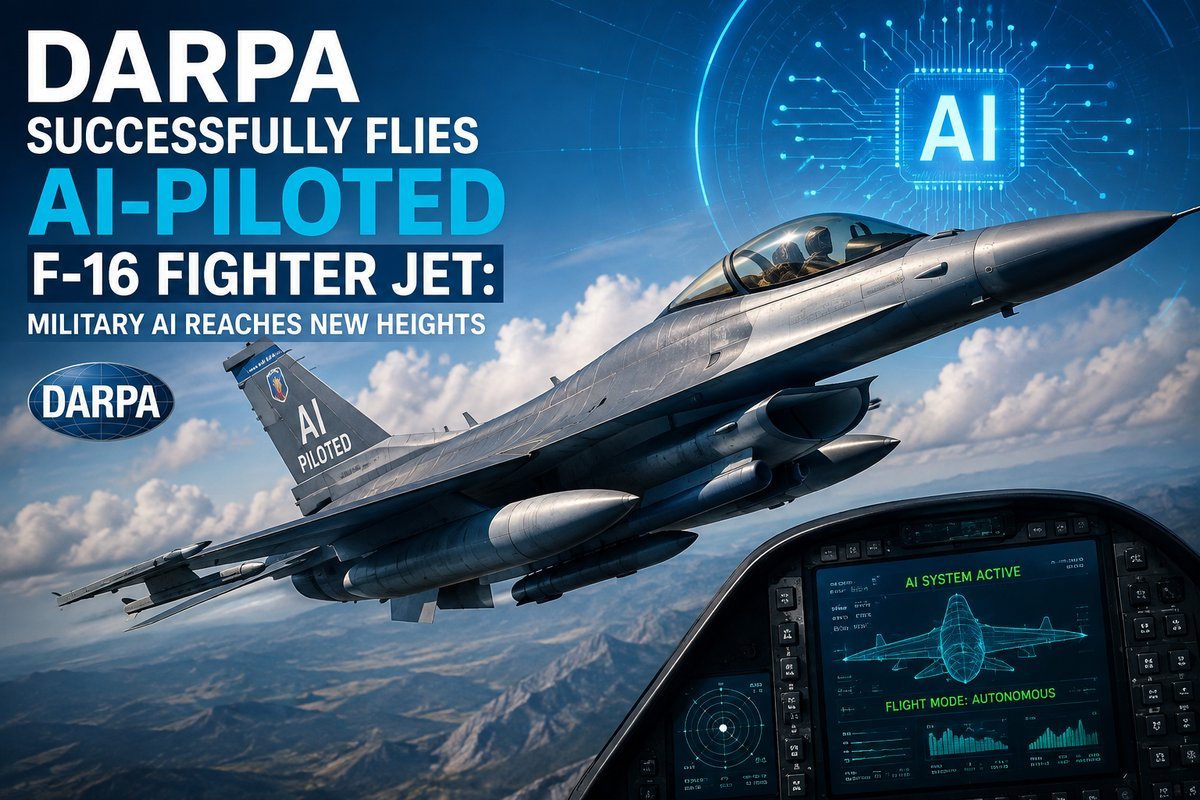
Under DARPA’s Air Combat Evolution (ACE) program, an AI system was tested aboard the X-62A VISTA, a modified F-16 used as a testbed for advanced flight-control technologies. During portions of testing, the AI system controlled the aircraft while a human pilot remained onboard as a safety measure.
The achievement represents an important milestone in autonomous aviation and raises a larger question: how much of future aerial combat could be handled by artificial intelligence?
What Actually Happened?
The aircraft involved in the testing is the X-62A VISTA, a modified F-16 designed to evaluate advanced flight systems and autonomous technologies.
Unlike a conventional flight simulation, the ACE program involved testing AI control during real-world flight operations. The system was developed to perform complex fighter-aircraft maneuvers and respond to changing flight conditions.
A human pilot remained available to monitor the aircraft and intervene if necessary. This human-supervised approach is an important part of safely testing autonomous flight technology.
The significance is not simply that AI can control an aircraft. The bigger achievement is demonstrating that machine-learning-based systems can operate within the demanding environment of a high-performance fighter aircraft.
Why Use an F-16?
The F-16 is one of the most extensively tested fighter aircraft in aviation history.
Its high maneuverability, well-understood flight characteristics, and extensive engineering data make it a valuable platform for experimental research. Rather than developing an entirely new aircraft, researchers can use an established platform to test new software and control technologies.
The X-62A VISTA essentially provides a bridge between advanced AI research and real-world fighter aviation.
What Is DARPA’s ACE Program?
ACE stands for Air Combat Evolution.
DARPA created the program to investigate how artificial intelligence could support or perform complex air-combat tasks traditionally handled by highly trained pilots.
The objective is not simply to replace human pilots. A major focus is developing effective human-machine teaming, where AI can assist pilots, operate alongside them, or potentially perform specific missions autonomously.
This could eventually lead to aircraft where AI handles certain high-speed decisions while human operators retain overall mission authority.
How Did the AI Learn to Fly?
Teaching an AI to control a fighter aircraft is very different from programming a conventional autopilot.
The system can be trained extensively in simulated environments before being introduced to real aircraft. Virtual environments allow researchers to expose the AI to enormous numbers of flight scenarios without putting pilots or aircraft at unnecessary risk.
Through repeated training and evaluation, the AI can learn how different control inputs affect the aircraft and how to respond to changing conditions.
The critical challenge comes when that software moves from simulation into the real world.
Real aircraft experience variables that are difficult to reproduce perfectly in a computer model, including atmospheric conditions, sensor limitations, aircraft dynamics, and unexpected situations.
Successfully transferring AI capabilities from simulation to real flight is therefore a major technical milestone.
Why AI Could Matter in Air Combat
Modern aerial combat is increasingly dependent on speed, information, and decision-making.
A human pilot must interpret sensor information, understand the tactical environment, control the aircraft, communicate with other forces, and make decisions under extreme physical and psychological pressure.
AI systems could potentially process large amounts of information extremely quickly and continuously evaluate possible responses.
Faster Decision-Making
AI does not experience fatigue in the same way humans do and can process information at machine speed.
In situations where fractions of a second can matter, faster processing could provide an important operational advantage.
However, speed alone is not enough. AI systems must also be reliable, predictable, secure, and capable of operating safely when conditions differ from their training environment.
Reducing Risk to Human Pilots
Autonomous aircraft could eventually perform missions considered too dangerous for human pilots.
Removing the need to place a person inside every aircraft could reduce the risk of casualties while allowing military forces to operate aircraft in environments where human survival would be extremely difficult.
This is one reason autonomous combat aircraft are attracting significant interest across the defense industry.
The Bigger Defense Technology Race
AI-powered aviation is part of a much larger transformation in military technology.
Artificial intelligence is already being explored for intelligence analysis, surveillance, logistics, electronic warfare, autonomous systems, and decision support.
The development of autonomous fighter aircraft could become another major area of competition among advanced military powers.
The United States is not the only country researching autonomous military aviation. As AI technology improves, other nations are also investigating ways to integrate machine intelligence into future defense systems.
What Could Future Fighter Aircraft Look Like?
The fighter aircraft of the future may look very different from today’s platforms.
Some aircraft could operate without a traditional cockpit and be designed primarily around autonomous operation. Others could continue to carry human pilots while using AI as an advanced decision-support and flight-management system.
Another possibility is a mixed fleet in which crewed fighters operate alongside autonomous aircraft designed to perform specific missions.
In such scenarios, AI could potentially handle navigation, sensor management, threat assessment, formation flying, and other demanding tasks while human operators remain responsible for critical decisions.
The Ethical Questions
The technical progress also creates difficult ethical and strategic questions.
If an autonomous system makes a mistake during combat, who is responsible? How much authority should an AI system have over decisions involving the use of force? What safeguards should be required before autonomous systems are deployed operationally?
These questions are becoming increasingly important as military AI moves beyond research laboratories and into real-world testing.
Human oversight remains a critical component of current development. Building reliable systems will require extensive testing, clear rules of engagement, cybersecurity protections, and robust mechanisms for human intervention.
What Comes Next?
The X-62A VISTA tests are not the end of autonomous fighter development. They are part of a much larger effort to understand what AI can realistically accomplish in high-performance aviation.
Future testing is likely to focus on increasingly complex scenarios, improved reliability, human-machine teaming, and the ability of autonomous systems to operate safely under unpredictable conditions.
The ultimate objective is not simply to make a fighter jet fly itself. It is to determine how artificial intelligence can provide a meaningful advantage while maintaining safety, human oversight, and operational control.
Key Takeaways
- DARPA’s ACE program has demonstrated important advances in AI-controlled fighter aviation.
- The X-62A VISTA, a modified F-16, serves as a real-world testbed for autonomous flight technologies.
- AI could potentially provide faster information processing and decision-making during demanding missions.
- Autonomous aircraft could eventually reduce the exposure of human pilots to dangerous missions.
- Human-machine teaming is likely to remain an important part of future military aviation.
- The technology also raises significant questions about accountability, human control, safety, and the use of autonomous systems in warfare.
The AI-piloted F-16 is therefore more than an impressive aviation experiment. It represents a glimpse into a future where artificial intelligence could become an integral part of how air forces operate, make decisions, and conduct missions.